

By Dr. Jackie Wirz, Executive Director, Link Oregon
February 27, 2026
Last week, I joined the Oregon Hazards Lab (OHAZ) and the Oregon Department of Forestry to present to the Joint Legislative Committee on Information Management and Technology on the essential role of resilient broadband in seismic and wildfire monitoring.
In my testimony, I stressed a straightforward but crucial point: hazard detection only protects Oregonians if the data can move—reliably, securely, and in real time. Oregon’s seismic stations and wildfire cameras depend on persistent, high-capacity network infrastructure, and Link Oregon’s 2,500-mile fiber backbone and 24/7 monitored network make that possible. When seconds matter—from earthquake early warning to wildfire detection—network performance under stress isn’t a nice-to-have; it’s a necessity. Our network is built with redundancy and continuously monitored so we can keep data flowing when it counts most. In combination with the cutting edge computing being performed via OHAZ’s cameras and sensors, we are part of an early detection system that saves lives.
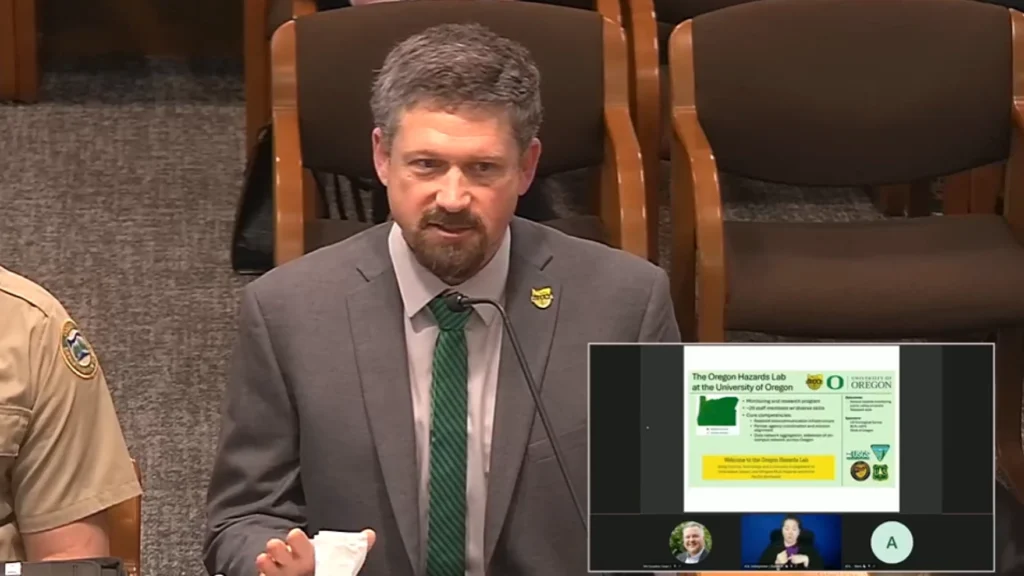
Leland O’Driscoll, director of the Oregon Hazards Lab, presenting to Oregon legislators (Credit: Video feed, Oregon Legislature)
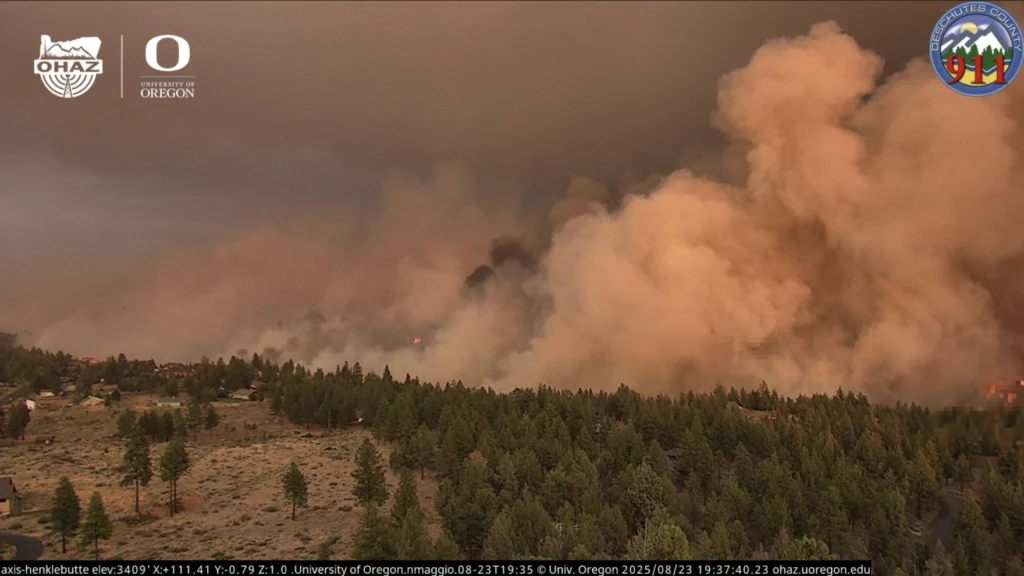
Still image of the Flat Fire in Oregon on Aug. 23, 2025 captured by a OHAZ camera. (Image credit: University of Oregon)
I met directly with the committee’s co-chairs before and after the meeting to advocate for sustained investment in Link Oregon as critical state infrastructure. We focused on the importance of maintaining funding through FY27 to ensure that Link Oregon can continue to support essential systems like OHAZ. I emphasized that proactive investment in resilient infrastructure is far more responsible—and cost-effective—than scrambling to rebuild after failure.
This collaboration adds a dimension to the value of Link Oregon’s resilient network. Beyond supporting education, research, workforce development, and economic growth, our infrastructure clearly underpins essential public safety capabilities. By connecting field sensors to researchers, emergency managers, and communities in real time, Link Oregon turns raw data into actionable information that helps keep Oregonians safe. From classrooms to command centers, resilient connectivity is foundational to the state’s long-term security and prosperity.
“All the science in the world and all the detection in the world doesn’t save lives unless you can get it to the community.”
— Doug Toomey, Oregon Hazards Lab
“Link Oregon has the speed to turn data into insight into action — ensuring the safety of our communities.”
— Jackie Wirz