

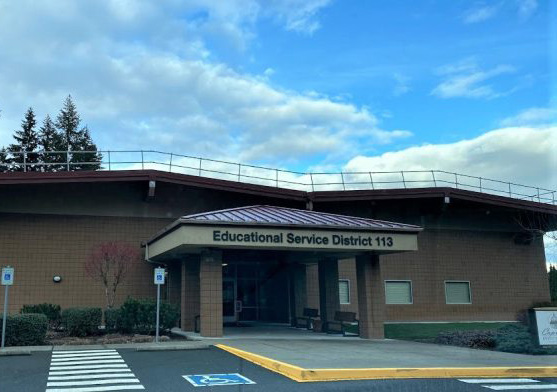
As Link Oregon works to bring the benefits of eduroam, the global wireless authentication service for research and education, to Oregon’s K-12 ecosystem, we’ve found insight and inspiration across the Columbia River. Link Oregon and Washington State’s Education Network (WA K20) are the designated eduroam Support Organizations for our respective states, and together, we’re building a regional collaboration to catalyze eduroam adoption in schools. We were particularly intrigued by ESD 113 in Washington, which has become a practical testing ground for K–12 eduroam implementation in our region. ESD 113 serves 44 school districts, five counties and one Tribal Compact School, and directly manages technology services for many of them.
The interview below is based on our conversation with Brandon Kahler, Director of Technology Services at ESD 113. Brandon has been on the front lines of energizing eduroam adoption within the districts he supports.
His remarks point to a potential path forward for ramping up K–12 eduroam adoption in Oregon.
Q: What was the first key learning from your early eduroam outreach across ESD 113 districts?
BK: We realized that our early efforts failed to gain momentum not because districts opposed the concept, but because the messaging was misaligned.

Brandon Kahler, Director of Technology Services at ESD 113 (WA) is moving the needle on eduroam adoption by meeting his districts where they are at.
Technical staff didn’t respond to high‑level digital equity narratives; they wanted a concrete, technical explanation of how eduroam fits into infrastructure they already run. Some of ESD 113’s districts already use RADIUS servers and username‑based Wi‑Fi authentication. We’re telling them that eduroam simply mirrors that setup under a new SSID and adds one upstream connector—nothing more. Framing the story that way immediately reduces the friction point.
This specificity, not aspirational language, helped us start making inroads. IT implementers care deeply about the “five‑foot view.” “What buttons do I push?” and “How does this differ from what I already run?”—that’s where their heads are at.
Q: ESD 113 has been championing a “tiered model” for eduroam adoption. What does that look like in practice?
BK: One of the biggest friction points was reluctance among school districts to take on a change of large scope. Anything perceived as too big of a lift was a non‑starter. Smaller districts often cannot begin as identity providers (IDPs) because they lack username‑based authentication. We’ve had more interest since sharing our vision of a tiered model: start as an eduroam Service Provider (SP) first, then later expand to more advanced connectivity by becoming an Identity Provider (IDP).
Becoming an eduroam SP requires about four configuration inputs and five minutes of work. It’s that quick and immediately enables Wi Fi access for visitors from any eduroam enabled institution using their home credentials. Becoming an IDP allows a district’s own users to take their home credentials anywhere in the world and connect to eduroam.
Because some of our smallest districts don’t host servers on site, ESD 113 offers hosted RADIUS servers dedicated to eduroam at no cost. Larger districts with existing authentication systems can onboard directly to SP status without hosted infrastructure. With minimal tweaks to their setup, we can get these institutions up and running as eduroam service providers very quickly.
Q: Any surprising use cases that challenged your assumptions on the eduroam rollout journey?
BK: Yes—the Running Start students. The long‑assumed scenario was that a high school student takes a district‑managed device to college and needs eduroam there. But district content filters block college coursework on those devices, making that scenario less relevant among the folks we spoke to.
Key Learnings from WA-113’s Eduroam Rollout
- Tailor the story/message to the audience. Digital equity narratives resonate with district leadership; IT teams, however, want the nuts and bolts of how eduroam fits into their existing infrastructure.
- Start small with a tiered model of adoption. Becoming an eduroam SP is a quick-to-implement, high value win. Use that momentum to grow into full IDP capability.
- Human support is key. Documentation alone won’t move the needle with smaller districts. Early, hands on guidance is what gets them over the finish line.
What we discovered is a need that exists in reverse. These students use personal laptops at the college where they take classes, authenticate with college credentials, then return to their high school campus. Eduroam allows the district to recognize the college credential and grant appropriate access, instead of treating the student as a filtered guest.
This use case hadn’t been widely recognized, but it resonated with many districts we spoke with.
Because some of our smallest districts don’t host servers on site, ESD 113 offers hosted RADIUS servers dedicated to eduroam at no cost. Larger districts with existing authentication systems can onboard directly to SP status without hosted infrastructure. With minimal tweaks to their setup, we can get these institutions up and running as eduroam service providers very quickly.
Learn more about how eduroam can benefit your students, educators, and district visitors.
Link Oregon is Oregon’s sole Support Organization for eduroam for K-12, museums, and libraries. We welcome your inquiries on how to get started.