

By coordinating notifications, sharing fiber and staff, and centralizing core security services, a regional powerhouse team is demonstrating the potential of trusted coalitions
At the Link Oregon Annual Member Meeting on June 23, we convened a Central Lane panel featuring spokespeople from Connected Lane County, the City of Eugene, and the Lane Council of Governments (LCOG). The panel, “Regional Planning and Collaboration Across Agencies,” showcased a decades‑old coalition that has reshaped how Central Lane has strategically flexed its regional planning muscle to deliver practical advantages for its residents: lower costs, faster projects, reliable online services, timely emergency response, and stronger cybersecurity.
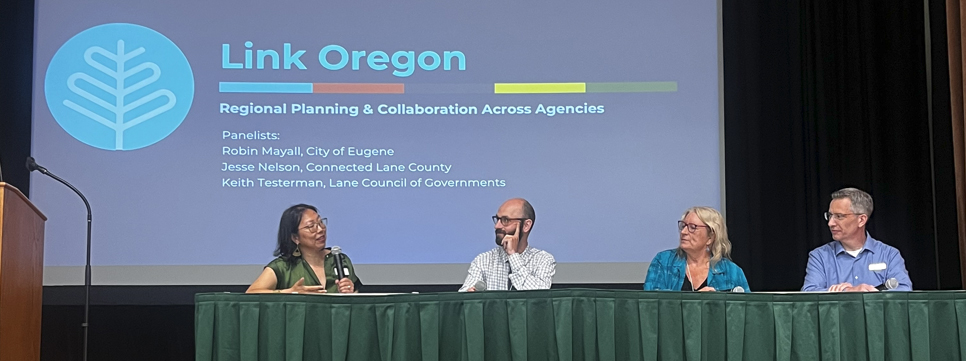
Link Oregon Executive Director Jackie Wirz (far left) moderates a panel at the 2026 Annual Member Meeting with (left to right) Keith Testerman, Data Center and Systems Manager, Lane Council of Governments; Robin Mayall, Director of Information Services, City of Eugene; and Jesse Nelson, Executive Director, Connected Lane County
Why Collaboration Doesn’t Start with Infrastructure
Local governments like the City of Eugene and LCOG continue to face rising cyber threats, tight budgets, and growing demand for online services. Problems and needs routinely cross county and city lines. Shared digital infrastructure — jointly managed software, public agency fiber, and coordinated planning—can enable agencies to deliver better services more affordably than going at it alone.
Collaboration is the logical approach to accomplishing that. In practice, however, panelists emphasized that creating a culture of collaborative problem-solving stands on years of investment in relational trust.
“You can’t just start with infrastructure. You need trust, accountability, and the willingness to have difficult conversations with partners,” noted panelist Robin Mayall, Director of Information Services, City of Eugene. She added, “In Lane County, collaborative culture has transcended any individual leader.”
How Collaboration Works in Practice
Dig once and plan together
Eugene’s pilot “dig once” approach is working to coordinate public works, planning, and IT so that in the future, broadband conduit can be installed whenever key streets are reconstructed. This has the potential to convert routine capital work into long‑term digital investment, preventing repeated excavation and creating predictable windows to expand regional connectivity. The City has explored installing broadband conduit during a recent road reconstruction, in partnership with LCOG and the University of Oregon, and hopes to expand on this kind of project in the future.
Pooled staffing and managed services
Smaller jurisdictions often can’t recruit or retain specialized IT talent. LCOG includes a diverse mix of 35 member organizations — including Lane County, 12 cities, six school districts, one education district, one college, two parks and recreation organizations, three library districts, five utilities, a transit district, two fire districts, an ambulance district, and a port. It offers a managed services model that supplies technical talent and support across agencies so each jurisdiction benefits from enterprise skills without stretching hiring budgets. The result is faster incident response, consistent patching and monitoring, and continuity through staff turnover.
Shared fiber and redundancy
The region leverages shared fiber assets instead of leasing every circuit from commercial carriers. Those assets support data transfer, backups, and disaster recovery — critical capabilities when a single outage could disrupt multiple public services. Mayall noted, “Leasing all our fiber from commercial entities would have meant enormous costs and could come at the expense of other critical services for our constituents. We’re continuing to see the value of what we chose to build and share decades ago.”
Data and GIS as common goods
Standardized GIS and regional data platforms let agencies in the region reuse datasets for planning, emergency response, and service delivery while working from the same map. This means cross‑jurisdiction projects move faster and with fewer surprises.
What Makes Collaboration Sustainable
Building culture takes much longer than building infrastructure. Mayall noted in her interview with Link Oregon that investments rarely pay off immediately. “It takes a while, so you have to look for a coalition of the willing. You’re looking for like‑minded allies with shared values. And of course, collaboration has to be codified in interagency agreements or MOUs (memorandums of understanding).” That combination—shared values and codified agreements—helps collaboration survive budget cycles and leadership changes.
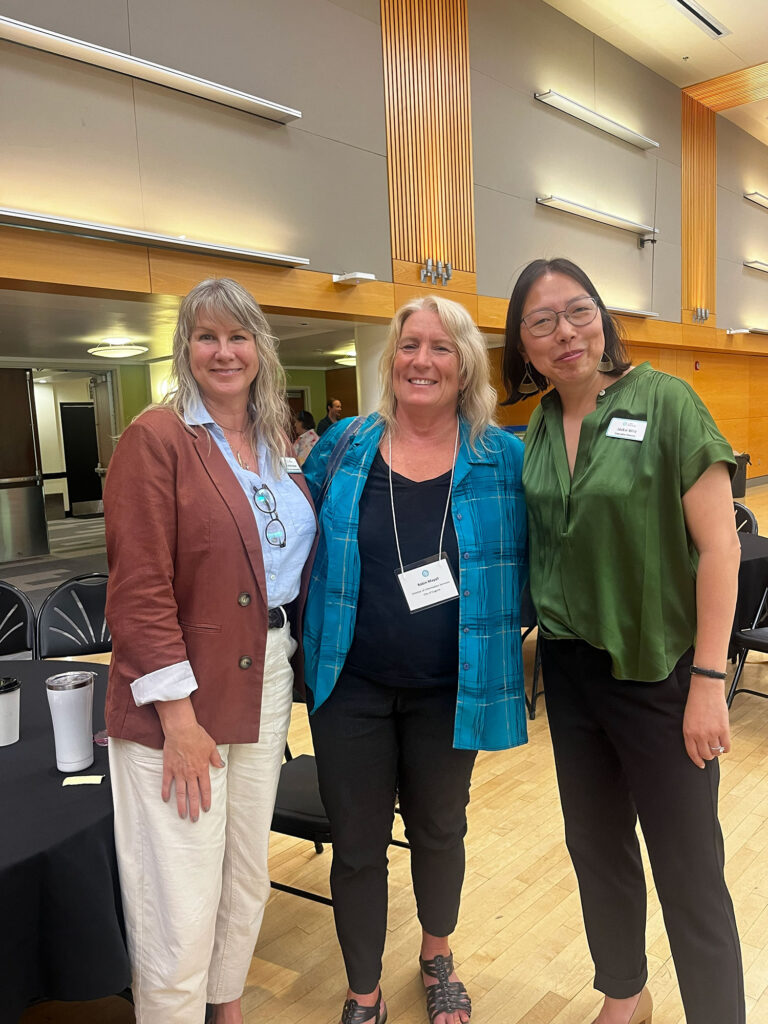
Robin Mayall (center), Director of Information Services, City of Eugene, with the Link Oregon team at our 2026 annual member meeting
Link Oregon is proud to have the City of Eugene, Eugene Water & Electric Board (EWEB), and Lane Transit District among its members.